Munich
Death in VeniceMunich is Gustav von Aschenbach’s established home, the setting of the walk that first awakens his desire to travel, and the point from which he departs for the south. It embodies the orderly life of work and self-command that he has made for himself; yet the city’s familiar routines can no longer relieve his exhaustion or resolve his creative deadlock. The journey begins not with a settled plan but with a disturbance that Aschenbach tries to reason away, then gradually accepts as necessary.
Home and settled life
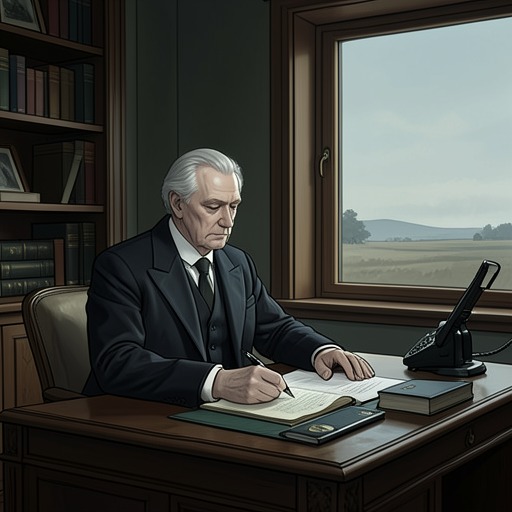
After a few years of restlessness and tentative stopping-places, Aschenbach chose Munich as his permanent home. He lived there with middle-class respectability, a life suited, the narration suggests, to the intellectual career he had constructed. The marriage he had entered while young ended when his wife died after a brief period of happiness; their daughter was now married, and he had never had a son. By the time of the story’s opening, the city was the central setting of an existence narrowed around work and routine.
His home life was divided between Munich and a rough country house in the mountains, where he spent rainy summers. He had confined his outer existence almost entirely to the city that had become home and that mountain retreat. Travel, when he could afford it, had generally seemed to him a hygienic necessity rather than a pleasure: he was occupied with the demands of writing and with what the narration calls the problems of Europe, and had never been tempted to leave the continent. Munich therefore represents not simply a residence but the stable orbit within which he had expected to finish his life’s work.
The walk and the disturbance
On a spring afternoon in the year 19—, Aschenbach left his apartment on the Prinzregentenstrasse for a long walk. The morning’s precarious labor had kept his productive impulse running after lunch; exhausted, he could not obtain the midday sleep he needed. He went outdoors after tea in the hope that air and movement would restore him for the evening’s work. The beginning of May brought a false midsummer after weeks of cold damp weather, and the English Gardens were crowded nearer the city. Aschenbach walked on to the Aumeister, then started home as the sun sank and a storm threatened from the direction of Föhring.
Tired, he waited for a tram at the North Cemetery. The station and its surroundings were empty: no vehicle moved along the Ungererstrasse or the Föhringer Chaussee, and the stone-masons’ displays of crosses and monuments seemed like a second burial ground. Across from him, the Byzantine funeral hall stood in the fading light, its colored façade marked with Greek crosses and gold-lettered inscriptions about the life beyond. Aschenbach occupied himself by reading the formulas and letting his mind wander through their mysticism. Then he noticed a strange-looking traveler near the portico, and the stranger’s foreign appearance redirected his thoughts.
The stranger met Aschenbach’s gaze with such open militancy that Aschenbach turned away and resumed walking. Although he soon forgot the man, the encounter—or the foreignness that had caught his imagination—stirred a new restlessness. He stopped with his hands behind his back and his eyes on the ground, trying to identify the feeling. It was, he realized, a desire for travel: sudden and unusually powerful, swelling into a passion and even a kind of hallucination. His imagination supplied a tropical wilderness of bogs, stagnant water, extravagant vegetation, strange birds, and a tiger glimpsed through bamboo. The vision vanished, but the longing it had given form to did not.
Work, resistance, and decision
At first Aschenbach tried to subordinate the impulse to his accustomed discipline. He had intended to advance his life’s work to a particular point before moving to the country; months of travel and neglected work seemed lax and contrary to his plans. He understood the desire as an urge to escape from labor, a craving for novelty, freedom, relief, and forgetfulness. He loved his work, and even the enervating daily contest between a tenacious will and a growing fatigue; but the strain could no longer be denied simply because his public work showed no weakness.
The creative impasse made the prospect of continuing at home especially difficult. Aschenbach revisited the passage at which he had stopped the day before and again that day, but it yielded neither to patience nor to a direct assault. The obstacle was not an unusual technical difficulty so much as a fastidious dissatisfaction that had characterized him since youth. He still possessed his craft with confidence, and the nation honored him, yet he felt his work lacked the fiery, fluctuating emotionalism that could give an audience pleasure beyond the depth of its content. Munich’s security could not supply what he believed his art now needed.
He also feared returning to the familiar summer at the country house: the solitude, the maid who prepared his meals, the servant who brought them, and the unchanging view of mountain peaks and slopes that would surround him with boredom and discontent. If summer were to remain endurable and productive, he reasoned, he needed a break in a new direction, a change of air and a freshness that would reach even the blood. He settled on travel, but initially limited its ambition: one night on a sleeper train and three or four weeks at a pleasant southern resort, not a journey as far as the imagined tigers.
As the electric tram approached along Ungererstrasse, he made his decision concrete: that evening he would study maps and timetables. On the platform he looked for the man in the straw hat who had shared the cemetery wait, but the stranger was nowhere in sight, either at the station or on the tram. The absence leaves the encounter unexplained; its importance lies in the new appetite it had set loose in Aschenbach, not in any established connection between the two men.
Departure and narrative significance
Literary and social obligations delayed Aschenbach’s departure for about two weeks after the walk. He ordered the country house made ready for occupancy within a month, then left Munich by night train for Trieste, traveling onward to Pola the next morning. His first chosen island resort disappointed him: rain, heavy air, a provincial hotel clientele, and the absence of a soft sandy beach kept him from finding the restorative intimacy with the sea he wanted. He studied sailing dates and reconsidered his destination, recognizing that he had lost the trail of the place he had meant to reach. A week and a half after arriving, he returned by motorboat to the naval port and boarded a ship bound for Venice.
The route away from Munich turns an abstract wish for escape into a chain of decisions, changes of direction, and increasingly specific destinations. In Munich, Aschenbach’s artistic discipline remains strong enough to challenge the desire but no longer strong enough to extinguish it. The walk begins as a practical attempt to recover strength for another evening of work; it ends as the first break in the life he had confined to his home city and mountain retreat. Munich consequently serves as the novel’s threshold: the familiar world against which the pull of the foreign and remote first becomes legible.